.png)

Animals of the Amazon Rainforest | The Guide to 10 Species to See
- Jun 1
- 5 min read
The Brazilian jungle is fascinating in its immensity, but it is above all the animals of the Amazon rainforest that leave a lasting impression. Between the cries of monkeys, the flights of multicolored parrots, and the sudden silence when a predator approaches, every moment seems to be taken from a documentary.
Since our isolated lodge located about four hours from Manaus, in the heart of the Brazilian Amazon, we guide European travelers seeking authentic experiences and powerful wildlife encounters. In this highly visual nature guide, we present ten of the most fantastic animals of the Amazon rainforest to observe, while explaining where, when, and how to see them safely and with minimal environmental impact.
Naturalist guide: 10 fantastic Amazon rainforest animals to see in the Brazilian jungle
Brazilian Amazon rainforest: a territory of magical wildlife
The Brazilian Amazon rainforest is often described as a green lung for the planet. Scientists have documented exceptional biodiversity and a magical fauna with almost unreal colors and behaviors. Here, predators move silently, birds seem hand-painted, and insects compete in ingenuity to camouflage themselves. Jaguars patrol the riverbanks, sloths swing through the canopy, tarantulas emerge at nightfall, and toucans enliven the mornings with their raucous calls.
To fully appreciate these animals, the company of a naturalist guide is essential. We work with passionate local guides who know the habits of each species and can spot the slightest clues: footprints, calls, movements in the foliage.
Why a secluded lodge increases your chances of seeing wildlife
Many visitors stay in accommodations near Manaus: convenient, but the human impact is greater there and some animals are less visible. Sleeping in a secluded lodge about four hours from the city completely changes the experience.

Our lodge is located in a dense and sparsely populated forest area, offering several advantages:
Wildlife is less accustomed to noise and artificial light, therefore more active.
Canoe trips take place on calm waterways where caimans, giant otters and anacondas are often spotted.
Night walks allow you to observe tarantulas, tree frogs and insects with a unique intensity.
Our trips are all-inclusive: transportation to/from Manaus, accommodation, meals, activities, and a guide. By choosing local partners and an eco-responsible approach, we minimize our impact on this precious Amazonian wildlife. For a concrete idea of the landscapes, browse our photo gallery of the Amazon rainforest.
10 fantastic animals to observe in the Brazilian Amazon
Animal | Where to observe it | When to observe it |
Jaguar | Riverbanks in the Amazon rainforest | Mainly at night, sometimes at the end of the day |
Ferocious Harpy | Canopy top | During the morning outings |
Ocelot | Undergrowth and boat trips on calm rivers | Late in the evening |
Tapir | Near the rivers | — |
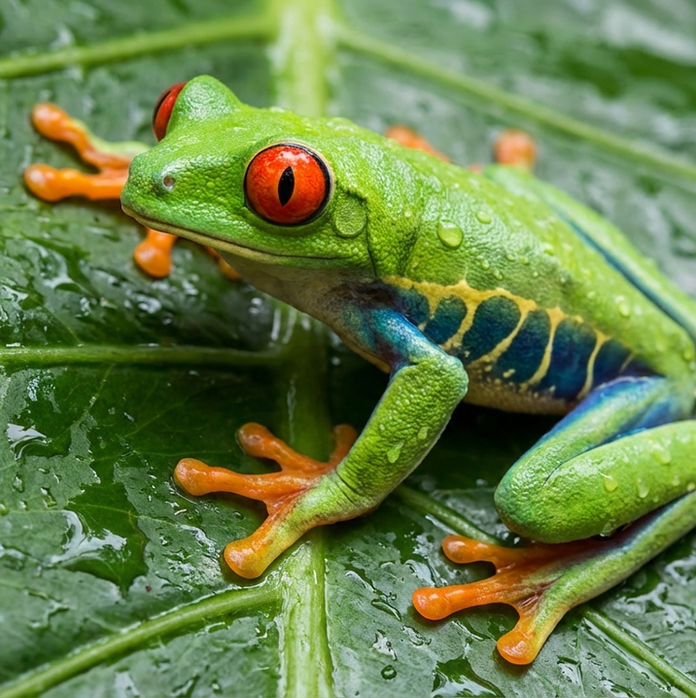
Red-eyed tree frog | On the leaves above the water | At night |
1 – Jaguar: the spotted ghost of the forest
An iconic predator that can reach two meters in length, the jaguar moves with absolute discretion, primarily at night. It is sometimes spotted at the end of the day when it travels along the riverbanks to hunt capybaras or caimans. Our guides carefully observe tracks and alarm calls to position you in the right spot without disturbing the animal.
2 – Harpy Eagle: Queen of the Canopy
With a wingspan that can reach two meters, this bird of prey, nesting high in the canopy, swoops down on monkeys or sloths with lightning speed. Early morning outings are ideal for trying to spot it.
3 – Ocelot: the discreet feline of the undergrowth
Smaller than the jaguar, the ocelot is nocturnal and agile. It is rarely spotted during the day, but observations are possible in the late evening during boat trips on calm rivers.
4 – Tapir: the prehistoric giant of the rivers
Large and with a small, trunk-like snout, the tapir is an excellent swimmer. It plays a crucial role in seed dispersal, acting as a true gardener of the forest.

5 – Three-toed sloth: the plant ghost
Its slow pace and fur, sometimes covered in green algae, provide perfect camouflage. With a little patience and the trained eye of the guides, you might spot it hanging from the branches.
6 – Macaw: the red flame of the sky
The scarlet macaw, a large parrot, soars through the sky uttering powerful calls. Morning and late afternoon are the best times to observe them in groups.
7 – Giant otter: the social ballet of the rivers
Measuring up to 1.80 m, the giant otter lives in noisy family groups that patrol rivers and lakes in search of fish.
8 – Red-eyed tree frog: the little neon of the leaves
A photogenic amphibian with bright colours, often observed at night, resting on a leaf above the water where it lays its eggs.
9 – Giant anteater: the termite specialist
Recognizable by its tubular snout and long tail, it can consume tens of thousands of insects per day by foraging in termite mounds.
10 – Green Anaconda: The Silent Legend of the Swamps
One of the world's largest snakes, living mainly in marshy areas. Encounters are rare and always conducted with respect for the animal and at safe distances.
Other unforgettable encounters
In addition to these ten fantastic animals, the Amazon rainforest of Brazil offers a myriad of other encounters: caimans, whose eyes reflect the light during night outings, tarantulas shyly settled at the edge of the paths and toucans recognizable by their enormous colorful beak and their raucous cries.
Our eco-friendly programs combine boat trips, daytime and nighttime walks, and moments of silent listening to the forest to maximize opportunities for observation. Discover our Amazon travel programs.
FAQ about wildlife viewing in the Brazilian Amazon
What is the best time to observe wildlife?
The drier season, from June to November, makes observation easier thanks to lower water levels that concentrate wildlife around rivers and lakes. The forest, however, remains vibrant year-round.
How many days should I plan for?
To fully enjoy and make the most of the four-hour journey from Manaus, we recommend spending several days there to vary the boat trips, daytime and nighttime walks.
Are the trips suitable for families or beginners?
Yes. Our all-inclusive holidays are designed for curious travelers, not just experts. The guides adapt to your level and make the experience fun, even for teenagers.
How can we reconcile observing and respecting wildlife?
We limit group sizes, maintain reasonable distances, and avoid feeding the animals. Our eco-friendly logistics minimize the impact on the animals and their habitats.
What equipment should I bring?
Bring binoculars, light, covering clothing, a headlamp for nighttime outings, and a camera if you wish. The guides will advise you on how to use them without disturbing the wildlife.
By choosing a secluded lodge in the heart of the Brazilian Amazon rainforest, you'll have the rare opportunity to encounter some of the most fantastic animals on the planet. Our all-inclusive, eco-friendly stays, led by English-speaking local guides, make this experience truly unforgettable.fRancophones, experience a deep immersion in the Amazonian wildlife while respecting it. Prepare your adventure by exploring our Amazon photo gallery and our various trip options.
Conclusion: Summary of a stay with the animals of the Amazon rainforest
This naturalist guide highlights the rich wildlife of the Brazilian Amazon rainforest and the importance of choosing a secluded lodge to maximize your wildlife encounters. By combining boat trips, daytime and nighttime hikes, and the guidance of passionate local guides, you increase your chances of observing jaguars, harpy eagles, giant otters, tree frogs, or even anacondas in a respectful manner.
By carefully planning your trip to the Amazon and choosing an eco-friendly approach, you contribute to the preservation of this unique territory while experiencing a profound immersion in the heart of the Amazon rainforest's wildlife. All that remains is to choose the time of year that suits you and the itinerary that best meets your needs to transform these encounters into unforgettable memories.


Comments