.png)

Brazil's Atlantic Forest | A rich and threatened ecosystem
- Jun 27
- 6 min read
When forests in Brazil are mentioned, the Amazon almost always comes to mind. Yet, another green giant harbors equally impressive biodiversity while facing far greater threats: the Mata Atlântica, the vast Atlantic Forest stretching along the coast. This biome once covered a massive swath of greenery spanning the country from south to north, reaching the borders with Argentina and Paraguay. Today, only a small fraction remains—fragmented and under constant pressure. Understanding the true nature of the Mata Atlântica, its critical importance for the climate and wildlife, and how to travel responsibly along the Costa Verde and in Paraty is, in itself, a first step toward commitment.
Mata Atlântica: the Atlantic Forest in Brazil, the most threatened and richest
What is the Mata Atlântica, the Atlantic Forest of Brazil?
Geographical extent of the Mata Atlântica
The Mata Atlântica is a vast tropical rainforest that historically extended over approximately 1.3 million km² along the Brazilian Atlantic coast. It covered nearly 15% of the national territory, from Rio Grande do Sul in the south to Rio Grande do Norte in the north, with some extensions into Argentina and Paraguay.
Scientists classify it among the world's major biodiversity hotspots: a region that is both extremely rich in species and extremely threatened. To earn this status, a region must be home to numerous endemic species and have lost more than 70% of its original vegetation; the Atlantic Forest far exceeds these thresholds. Today, only between 12% and 24% of the original forest cover remains, often in small, isolated fragments, which further weakens the species that live there.
Despite this decline, the Mata Atlântica remains an ecological pillar for Brazil: regulating local and regional climate, feeding numerous waterways, protecting soils from erosion, and providing drinking water to major cities like São Paulo and Rio de Janeiro. It also forms the backdrop to popular tourist coastal regions such as the Costa Verde and Paraty.
An exceptional biological richness
Diversity of flora and ecosystems of the Brazilian Atlantic Forest
The Brazilian Atlantic Forest is one of the world's richest forests in terms of plant species: approximately 20,000 plant species, including more than 8,000 endemic species. A 2024 study of nearly 5,000 tree species concluded that more than four out of five of the endemic species are now threatened.

This richness stems from the variety of climates and landscapes: hot and humid lowland forests, mountain forests up to 2,700 m, drier areas, high-altitude savannas, mangroves, and coastal restingas. Rainfall varies from 700 mm to over 4,000 mm per year, with climates ranging from subtropical to equatorial.
approximately 930 species of birds
over 500 species of amphibians
over 300 species of mammals
nearly 200 species of reptiles and several hundred species of fish
Iconic animals include the jaguar, puma, golden lion tamarin, several species of spider monkeys, toucans, and hummingbirds. This diversity allows travelers on the Costa Verde to go from a mountain trail covered in bromeliads and orchids to a mangrove-fringed beach, and then to a waterfall deep in the jungle, all in just a few hours.
Brazil's most threatened forest
An old and ongoing deforestation
Since the arrival of European settlers in the 16th century, the Mata Atlântica has lost between 72% and 92% of its area, initially due to sugarcane and coffee plantations, and subsequently due to urbanization, industry, and infrastructure development. More than four out of five forest fragments now cover less than 50 hectares, making animal populations too small and isolated to be viable in the long term.
Approximately 70% of Brazil's population lives in the former Atlantic Forest, and this area produces over 70% of the national GDP, meaning human pressure is at its highest. Current threats include urban and coastal expansion, mining activities, droughts and heat waves exacerbated by climate change, and ongoing deforestation. This biome is estimated to harbor about 60% of Brazil's threatened species.
Restore and protect the Mata Atlântica
Two large groups of reserves in the Mata Atlântica are listed as UNESCO World Heritage sites. Since the 2000s, federal laws have mandated the maintenance or replanting of native forest on rural properties. A national plan launched in 2017 aims to restore several million hectares by 2030. Between 2006 and 2023, the reforested area is estimated to have even exceeded the deforested area, thanks in particular to private reserves.
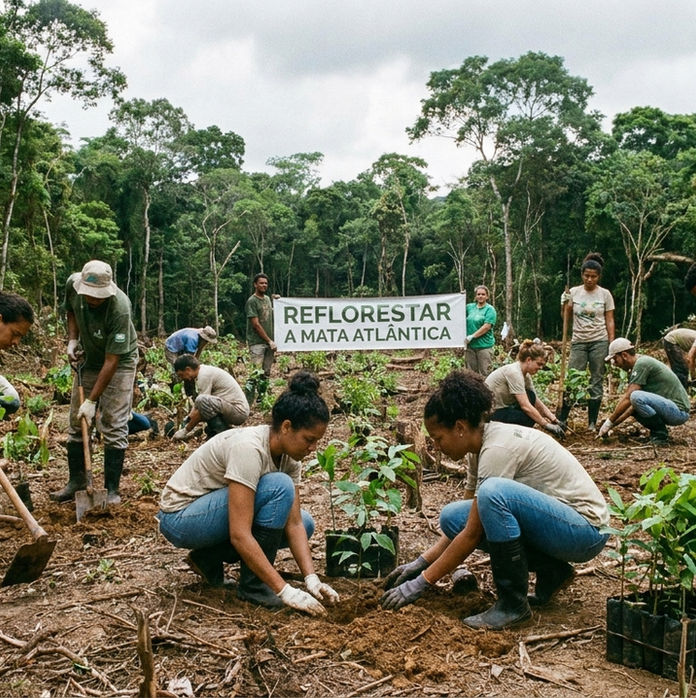
Organizations like SOS Mata Atlântica, WWF, and The Nature Conservancy create forest corridors, support private reserves, fund reforestation, and mobilize citizens. For travelers, supporting these efforts means choosing trips that collaborate with these initiatives rather than those focused on volume and short-term travel.
Costa Verde and Paraty: living showcases
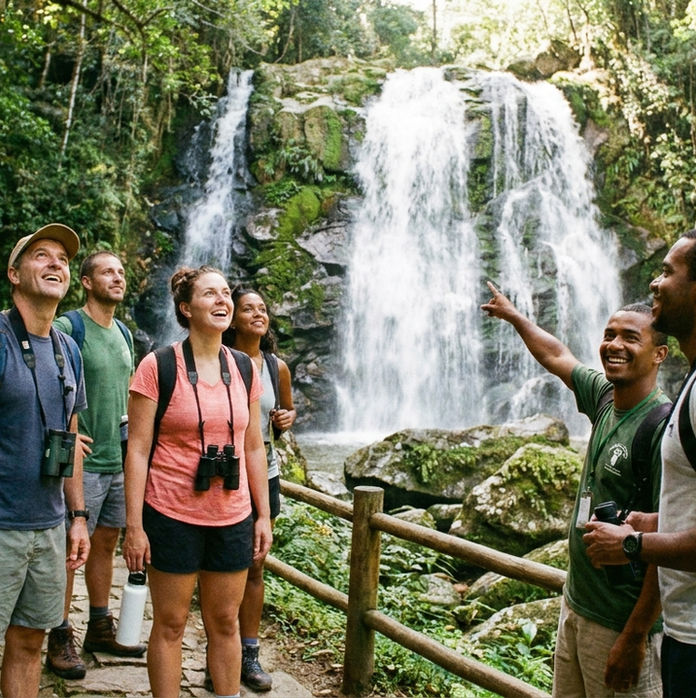
Between Rio de Janeiro and São Paulo, the Costa Verde and Paraty offer a rare forest-ocean continuum: forest-covered mountains descending to sheltered bays, wild islands, and coastal villages. In just a few days, visitors can hike in primary forest or secondary, observe colorful toucans and tanagers, bathe in tropical waterfalls, explore mangrove-lined beaches and meet caiçara communities living in close connection with the sea and the forest.
We offer eco-friendly tours on the Costa Verde and in Paraty, designed for European travelers, particularly French speakers. Small groups, intimate accommodations, committed local partners, and English-speaking guides experienced with European visitors: everything is designed for a truly immersive and respectful experience. The trips are all-inclusive (local transportation, accommodation, meals, activities, and tour guide) so you can focus on exploring.
Traveling without increasing pressure
Ecotourism can help preserve the Mata Atlântica, but only if it is practiced consistently. The right choices give economic value to the remaining forest, encouraging communities and decision-makers to conserve it rather than transform it.
To do | Don't do |
Choose tours with committed local guides favor small groups stay on marked trails limit waste and take plastic with you respect silence and distance from wildlife | feeding the animals picking plants, flowers or seeds using music or noisy devices venture off the marked trails |
Advantages and limitations of ecotourism
Ecotourism generates additional income: accommodation, food services, guiding, local transport, and handicrafts create a value chain directly dependent on the health of the forest. It also increases the visibility of this biome, often overshadowed by the Amazon. However, even sustainable tourism can cause negative impacts if visitor numbers become too high or are poorly managed: soil degradation, disturbance of wildlife, and transformation of villages. Not all operators claiming to be ecotourists necessarily implement responsible practices. Hence the importance of tours developed with trusted local partners and adapted to the actual capacity of the places visited.
FAQ
Is the Mata Atlântica the same thing as the Amazon?
No. The Mata Atlântica runs along the Atlantic coast, with mountains, fragmented forests, and heavy urbanization. The Amazon mainly covers the inland Amazon basin, with a more continuous and still largely intact forest; the species, landscapes, and human dynamics are different there.
Why is it said to be more threatened than the Amazon?
Because it has already lost the majority of its original forest cover; the Amazon, despite worrying deforestation, still retains about 80% of its forest area intact, compared to around 10% for the Atlantic Forest.
Is it still possible to see a real Atlantic forest while travelling?
Yes. On the Costa Verde and in Paraty, you can walk through areas of native, sometimes primary, forest, as well as areas undergoing restoration. Parks, private reserves, and UNESCO sites still protect landscapes close to their original state.
Is one trip enough to protect her?
A single trip alone is not enough; repeated choices by many travelers create momentum. By opting for eco-friendly tours, paying trained guides, and buying local, you make forest preservation economically viable, complementing protection laws and reforestation projects.
In summary
The Mata Atlântica is both a treasure trove of biodiversity and the most threatened forest in Brazil. Understanding its history, its richness, and its vulnerabilities allows us to appreciate the importance of the last bastions of Atlantic Forest, particularly on the Costa Verde and in Paraty. By choosing eco-friendly travel All-inclusive and built with local partners, you can explore this fascinating biome while actively supporting its protection. To plan your next nature getaway, you can already consider extending your experience with a few days at our lodge in Brazilian Amazon.


Comments