.png)

Carbon footprint when traveling in Brazil – Our tips for reducing it
- Jun 23
- 5 min read
Traveling to Brazil is a dream for many, but it also represents a significant carbon footprint, especially for those coming from Europe. This carbon footprint is primarily linked to long-haul flights. Between the long-haul flight, domestic travel, and accommodation choices, every decision counts. The good news is that you can significantly reduce your carbon footprint while experiencing an unforgettable immersion in the Amazon. By focusing on a specific region, prioritizing lower-emission transportation, and choosing eco-friendly accommodations, it's possible to halve or even reduce the impact of a typical trip by two-thirds. As a local agency committed to the Brazilian Amazon, we've designed our trips to provide you with concrete support for a more responsible travel experience.
Reducing your carbon footprint while traveling in Brazil
Understanding your carbon footprint while traveling in Brazil
The main sources of emissions to consider
Before trying to reduce your emissions, it's helpful to understand where they come from. For a European spending a few days in the Brazilian Amazon, the bulk of their carbon footprint is concentrated in four main areas:
The round-trip international flight
Potential domestic flights
Local transportation in the Amazon
Accommodation and daily activities
Long-haul flights remain by far the largest source of emissions. Limiting domestic flights is therefore a major first step. Once in Brazil, the choice of transportation (bus, boat, carpooling) and the way of getting around (walking, canoeing, dugout canoe) also play a significant role.
The Brazilian context is quite encouraging: CO₂ emissions per capita are around 2 tonnes, there's a national goal of carbon neutrality by 2050, and ambitious policies are in place regarding biofuels and deforestation reduction. For you, this means that by carefully choosing your route, transportation, and local partners, you can transform a potentially high-emission trip into an experience aligned with this transition dynamic.

Building a sustainable route in the Brazilian Amazon
Focusing on a single region to limit theft
Brazil is immense, on a European scale. Visiting multiple regions and using multiple domestic flights drastically increases your carbon footprint. Therefore, the number one rule for low-carbon travel is to focus on a single region and explore it thoroughly.
By choosing, for example, the Brazilian Amazon with departure and return from Manaus, you avoid taking several connecting domestic flights to Rio, Salvador, or Iguazu Falls. You gain in ecological coherence and quality of experience: taking the time to discover a territory rather than rushing over it.
Our lodge is located in the heart of the forest, about four hours from Manaus. The transfer from the city is included in our all-inclusive packages, which:
• avoids multiplying transfers and accommodations
• replaces several quick trips and transmitters with a single longer journey by boat or land transport.
The 3 to 5 day tours we offer provide an intense immersion without excessive transport consumption: you stay in the same geographical area, along the river and the forest.
Route selection | Estimated carbon impact | Benefit for you |
Connecting several major cities with domestic flights | High footprint (sum of flights) | Time spent in airports, fast pace |
Focusing on the Amazon, starting from Manaus | Reduced footprint (fewer flights) | More immersion, less stress, better knowledge of the territory |
Choose low-carbon transport locally
Prioritizing soft mobility in the Amazon
Once you arrive in Manaus, your transportation choices will determine the true environmental impact of your trip. Brazil recently adopted a "future fuels law" to decarbonize transportation and aviation through the use of ethanol, biodiesel, and sustainable fuels. In the Amazon region, we prioritize shared transportation, boat trips (dugout canoe or canoe) whenever possible, and hiking to observe the flora and fauna.
This sustainable mode of transport reduces carbon footprint and noise pollution for wildlife: you hear monkeys, birds, and the rustling of leaves rather than the constant hum of engines. In the city, during your visit to Manaus, using public buses and walking for short distances also helps to reduce your environmental impact.
Eco-friendly accommodations and activities in the Brazilian Amazon
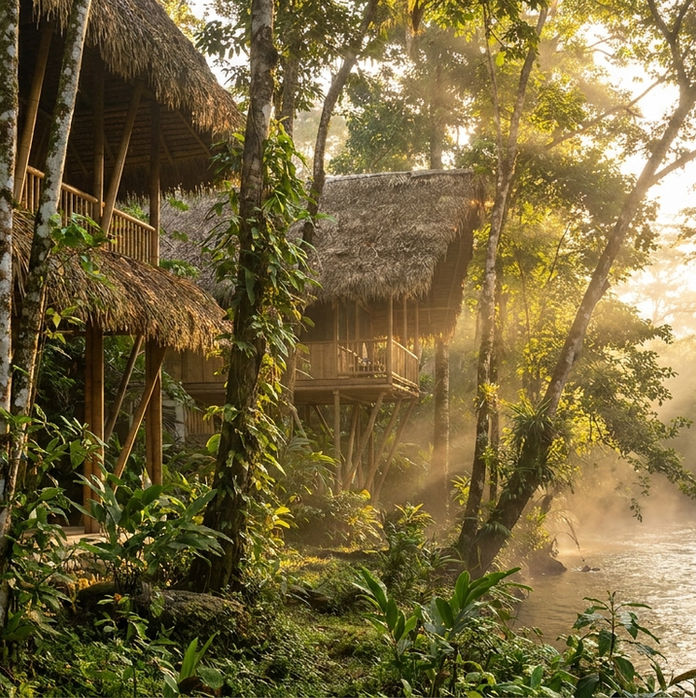
Accommodation is the other pillar of responsible travel. At our family-run lodge, we work with local partners and native forest guides. Our stays include accommodation, meals, activities, and English-speaking support to minimize intermediaries and unnecessary travel.
Eco-friendly accommodation in the Amazon is characterized by: limited capacity, careful management of water and energy, reduction of single-use plastics, support for the local economy, and active education for visitors. Our ecolodge stays follow this logic, far from mass tourism, with activities focused on observing and understanding ecosystems.
Beyond sustainability, we aim for regenerative tourism: reforestation projects, support for schools and social initiatives around Manaus, and long-term partnerships with local communities. This allows you to transform your presence there into a positive force rather than simply an impact to be offset.
Offsetting the emissions from your flight to Brazil
Even with an optimized route, a flight from Europe to Brazil still generates emissions. Carbon offsetting doesn't replace reducing emissions at the source, but it complements your efforts. Start by estimating your flight's footprint using recognized calculators, then fund certified projects that align with your values (reforestation, protecting existing forests, initiatives combining biodiversity and community support).
International standards ensure the traceability of emission reductions. As an agency specializing in Brazil, we can help you understand the role and limitations of carbon offsetting and choose reputable programs.
Practical tips and mini FAQs for a more responsible trip to the Amazon
Things to do to reduce your carbon footprint
Travel light to reduce the weight carried by plane and boat
Reusing a reusable water bottle instead of buying plastic bottles
Accepting simple comfort rather than energy-intensive equipment
Opt for observation on foot or by canoe rather than fast motorized excursions.
Follow the guides' instructions to avoid disturbing wildlife or damaging natural environments.
To be avoided as much as possible
Taking multiple domestic flights when your time is limited; demanding intense and permanent air conditioning; leaving waste behind during outings in the forest or by the river; buying souvenirs made from protected species or illegally harvested wood; getting too close to animals for photos, which stresses them and changes their behavior.
Does responsible travel mean giving up comfort?
Not necessarily. It's more about choosing simple comfort that's consistent with the environment: sleeping in a family lodge, eating local products prepared on site, and accepting the heat are all part of the Amazonian experience.
How many days should be planned for a responsible trip to the Amazon?
To limit domestic flights and maximize the impact of your international trip, plan for at least three to four full days at your destination. Our circuits are part of this timeframe, with a balance between sailing, walks in the forest and rest time.
Are the holidays suitable for families?
Yes, provided the children are prepared to spend a few days in direct contact with nature and experience a certain level of hardiness. The English-speaking guides will adapt the pace, explanations, and activities to your needs.
Is it possible to combine the Amazon and another region of Brazil without drastically increasing one's carbon footprint?
This is possible if you limit domestic flights. For example, opt for a nature extension in the Minas Gerais region rather than crossing the entire country. Our stays in the Serra da Canastra extend the immersion in nature into another iconic ecosystem.
Summary of a responsible trip to the Brazilian Amazon
By choosing a focused itinerary, sustainable transportation, an eco-friendly lodge, and a well-considered offset, you make your trip to the Brazilian Amazon consistent with your values. Discover the rainforest alongside local guides and support tourism that contributes to the ecological transition. To learn more, explore our stays in ecolodges or consult the page who are we.


Comments