.png)

How to recognize an eco-friendly lodge | Our criteria
- 3 days ago
- 5 min read
Do you want to sleep in the heart of the Amazon rainforest without compromising your environmental values? With a mix of genuinely committed accommodations and simple "nature" cabins, it can sometimes be hard to tell the difference. To help you navigate this, we review the key criteria of an eco-friendly lodge that you should know before booking. Water management, energy use, waste treatment, local employment, certifications, and transparency—these are all concrete factors that distinguish an authentic ecolodge from mere marketing hype. In this article, we provide practical guidelines for evaluating accommodation remotely, and then show how these criteria are put into practice at our lodge in the Brazilian Amazon, located four hours from Manaus.
How to recognize a true ecolodge and an eco-responsible lodge? Criteria to check
What truly defines an ecolodge
An ecolodge is not simply accommodation lost in nature with rustic decor. Ecotourism experts converge on a common vision: it is a small-capacity accommodation, designed to limit its environmental impact as much as possible, integrated into a preserved natural environment, involving local communities and offering an immersive and educational experience.
Respect for the environment:thoughtful construction, limited water and energy consumption, rigorous waste management, protection of biodiversity.
Involvement of local populations:jobs created in the region, use of local producers and artisans, sharing of profits with the community.
Raising awareness among travelers:explanations, discussions and supervised nature activities to better understand the ecosystem and the challenges of the territory.
A simple first indicator is to check if the accommodation clearly explains its approach. On the website, do you find a dedicated page on sustainable tourism or just a few words like "eco," "nature," and "responsible" without specific details? The more concrete examples an ecolodge provides (and even details of what it can't yet do), the more you can trust it.

Eco-friendly lodge: essential criteria to check before booking
To evaluate an ecolodge before booking, review eight main categories of criteria.
Construction and materials
Key points:Healthy and locally sourced materials whenever possible, bioclimatic design promoting natural light and ventilation, discreet placement that respects the landscape. A question to ask yourself: does the website describe the materials used and how the bungalows were built?
Energy and carbon sobriety
Key points:Prioritize reducing energy needs, use renewable energy sources adapted to the context, energy-efficient equipment (LEDs, optimized air conditioning), and monitoring consumption. Ask yourself if the establishment shares its energy policy with its customers.
Water management
Key points:Flow restrictors, rainwater harvesting where possible, and environmentally sound wastewater treatment (phytoremediation or equivalent). Check if the lodge provides details on these systems.
Waste and pollution
Key points:Limiting disposable packaging, visible sorting for travelers, composting of organic waste where possible, and eco-friendly cleaning products. What does the photo gallery show? Do we see single-use plastics?
Local roots and social impact
Key points: Local jobs, training, sourcing from local producers, promotion of local culture and crafts. Does the website mention any partner villages, cooperatives, or associations?
Biodiversity, location and mobility
Key points: Protection measures (reforestation, reduction of nighttime lighting), responsible mobility (shared shuttles, canoes, bicycles). Are local travel options consistent with the ecological approach?
Raising awareness among travelers
Key points: Information panels, nature workshops, a responsible traveler's charter, low-impact activities. Is the experience truly educational or merely decorative?
Governance, transparency and labels
Key points: A public CSR charter or policy, clear answers to customer questions, and the possible presence of regularly renewed independent certifications. Certifications are useful but do not replace transparency.
Practical checklist for evaluating an ecolodge remotely
Use this guide before booking your stay:

Criteria | Good sign | Question to ask oneself |
Charter and transparency | Dedicated page, specific examples | Does the lodge provide concrete data? |
Construction | Local materials, integration | Is the construction method described? |
Energy and water | Renewables, savings | How are electricity and hot water produced? |
Waste | Sorting, composting, little plastic | Is the waste management policy detailed? |
Impact local | Local team and suppliers | Are any partner names mentioned? |
Biodiversity | Protective actions | Are we talking about reforestation or protected areas? |
Awareness | Workshops, traveler's charter | Is there an educational aspect? |
Labels | Recognized independent label | Is the label verifiable and up-to-date? |
If several boxes remain empty or unclear, the risk of greenwashing increases, even when the communication emphasizes the "eco" aspect of the place.
How we apply these criteria in our lodge in the Brazilian Amazon
In the Brazilian Amazon, about four hours from Manaus, these criteria shape the way we welcome travelers. Our family-run lodge is integrated into the forest and built with a minimalist approach: limited impermeable surfaces, sustainable materials, and regular maintenance to extend the lifespan of the facilities. The architecture prioritizes the forest’s natural airflow over a large, standardized structure. You can get a glimpse of it on the page dedicated to our Amazon lodge.
On the energy front, we first reduce our needs: LED lighting, efficient air conditioning, natural ventilation, and anti-waste guidelines. Where logistics allow, we add reliable solar equipment, essential in the heart of the forest.
For water, we install economical devices, recover every liter possible and treat wastewater with appropriate systems so as not to degrade aquatic ecosystems.
Waste management is crucial in this isolated area. We limit individual packaging, use refillable products, and organize a sorting system that we then transport to the recycling facilities in Manaus. Separate bins are available, and our team explains the process to travelers.
Local employment is at the heart of our project. Our guides, natives of the region, share their intimate knowledge of the forest. We collaborate with local partners for fresh produce and activities, giving our Amazon eco-lodge stays a deeply immersive character.
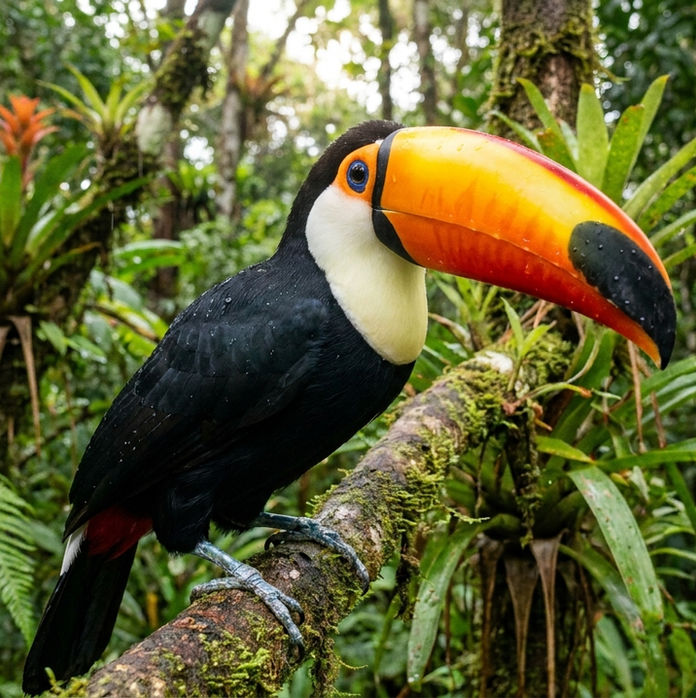
Each stay is all inclusive: transport to/from Manaus, accommodation, meals, activities and support by an English-speaking guide, which also reduces the logistical footprint.
Finally, raising awareness is an integral part of the experience. During outings, our guides share their knowledge of Amazonian wildlife, flora, and cultures. To learn more, visit the page Who are we as well as our customer reviews.
Frequently asked questions about eco-friendly ecolodges
Is an ecolodge necessarily very rustic and uncomfortable?
Not necessarily. An authentic ecolodge seeks a balance between comfort and simplicity: a good level of comfort is compatible with controlled consumption of energy and resources.
How to distinguish a genuine ecolodge from accommodation that is simply greenwashing?
Look beyond the photos. A genuine ecolodge details its approach, discusses local employment, water management, energy, waste, biodiversity, and provides precise answers to questions. A website that simply offers slogans without explanation is suspicious.
Are labels essential when choosing an ecolodge?
Sustainable tourism labels are a good guide because they involve external audits. However, in remote areas, not all reputable ecolodges have yet obtained them. If a label is unavailable, make sure the approach is explained transparently and that the actions taken meet the stated criteria.
Is a stay in an ecolodge in the Amazon suitable for families?
Yes, provided the lodge properly organizes the activities and clearly details what is included. We recommend stays of a few days, including boat trips, forest walks, and wildlife viewing, led by guides experienced in accompanying families.
In short, recognizing a true ecolodge means examining its construction, energy, water, waste, local integration, biodiversity, awareness, and transparency. An establishment that can concretely explain its actions on each of these points is far more credible than one that simply relies on green décor and a few slogans. If you would like to experience this in the Amazon, we invite you to discover our eco-lodge stays and the rest of our blog to prepare your trip responsibly.


Comments