.png)

Meeting of the Waters in Manaus | The mystery of the river explained
- May 20
- 4 min read
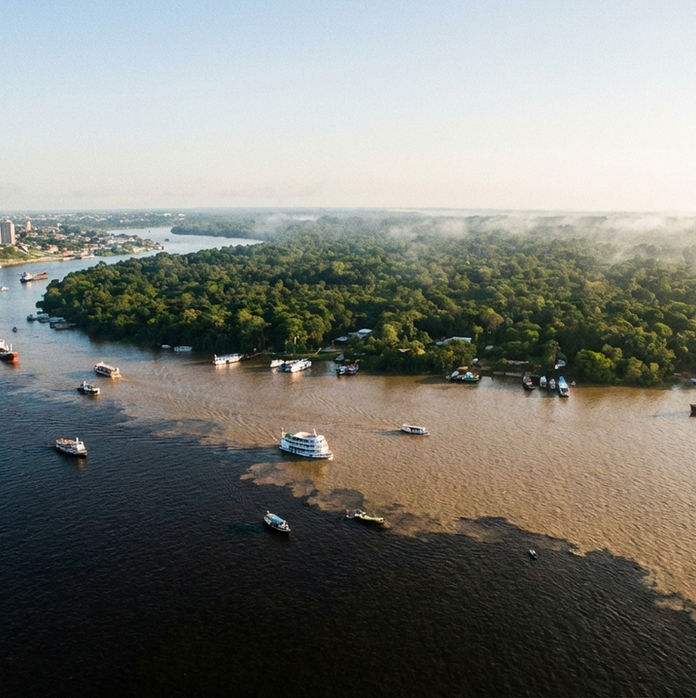
A few kilometers downstream from Manaus, a phenomenon unique in the world has intrigued travelers and scientists for decades. The meeting of the waters in Manaus, where the Rio Solimões and the Rio Negro unite without mixing, offers a spectacle that is at once mysterious, geological, and poetic. From the surface of the water as well as from the sky, this liquid boundary traces a clear scar between two worlds.
As travelers, you're not just observing two colors coexisting. You're witnessing a dialogue between the Andean mountains and the Amazon rainforest, between cold, fast-flowing waters and warm, calm ones. This powerful moment is part of the first day of all our All-inclusive tours in the Brazilian Amazon, before continuing on to our lodge located about four hours from Manaus, in the heart of the forest.
The mystery of the Meeting of the Waters in Manaus explained to travelers
What is known as the meeting of the waters at Manaus
The Meeting of the Waters, or Encontro das Águas in Portuguese, refers to the confluence where the Rio Solimões and the Rio Negro meet downstream from Manaus. It is from this point that the river officially bears the name Amazon. You are then faced with two liquid giants flowing side by side without mixing for several dozen kilometers.
On one side, the wide and powerful Rio Solimões displays a yellowish-ochre color because it carries significant sediments from the Andes. On the other side, the Rio Negro flows with dark, almost black water, tinted by organic matter from the decomposition of vegetation in the Amazonian plain.

For a traveler, the effect is striking: seen from a boat, the river's surface transforms into a painting divided into two distinct bands of color. In clear weather, this boundary is so sharp that it can even be seen in satellite images.
The geological background to the meeting of the waters of Manaus
If the waters of the Rio Solimões and the Rio Negro do not mix immediately, it is the consequence of very marked physical differences: temperature, speed, density, acidity.
River temperature, speed, and density
Characteristic | Solimões River | Rio Negro |
Temperature | Approximately 20–22 °C | Approximately 28–30 °C |
Flow rate | 4 – 8 km/h | 2 – 3 km/h |
Density | Denser | Less dense |
pH | ≈ 7 (neutral) | ≈ 5.5 (acid) |
Speed | Most importantly | Less bulky |
The colder, denser Rio Solimões flows faster than the warmer, slower Rio Negro. When the two meet, their water masses overlap and brush against each other; the Solimões tends to slide beneath the Rio Negro, delaying the mixing. It takes nearly 150 km downstream for the fusion to be complete.
Why do the colors remain so distinct?
The origin of each river also explains their colors. The Rio Solimões, which rises in the Andes, carries numerous suspended mineral particles that give it an ochre hue. The Rio Negro flows through marshes and flooded forests; the decomposition of vegetation there releases humic acids that color the water a deep brown, comparable to a very strong brewed tea.

Experience this unique spectacle from Manaus
The Meeting of the Waters is the major icon of Manaus. Most excursions depart from the port, go down the river to the area where the colors separate clearly, then continue towards more isolated areas.
In our trips, this step happens on the very first day before joining our lodge, about a four-hour drive, deep in the Amazon rainforest.
What does a typical day look like around the Meeting of the Waters?
Departure from Manaus by boat
Navigation to the meeting area; observation of the contrasts on each side of the boat before continuing towards the forest and our accommodation.
Practical tips for enjoying the Meeting of the Waters
Although the phenomenon is impressive all year round, a few precautions improve the comfort of the excursion.
Choose the right time and prepare well
Protect yourself from the sun: a hat, sunscreen and sunglasses are essential, as the glare is strong.
Pack a light rain jacket, especially during the wet season when the weather changes quickly.
Also consider your camera: the dividing line offers very photogenic plays of reflections.
Traveling in an eco-friendly way
The Amazon is both rich and fragile. By choosing excursions operated by committed local partners, you contribute to its preservation. Simple actions make a difference: don't throw anything into the river, limit single-use plastics, and respect the guides' instructions during stops.
Frequently Asked Questions about the meeting of the waters in Manaus
How long does the visible part of the Meeting of the Waters last?
The separation zone extends for several tens of kilometers downstream from Manaus; even a short excursion allows time to observe it from different angles.
Can you see the Meeting of the Waters without taking a boat?
There are viewpoints from the shore, but the most impressive experience remains the boat trip, getting as close as possible to the line of contrast.
Is it dangerous to navigate in the meeting zone?
Tourist excursions take place under controlled conditions: suitable boats, experienced guides, and well-known currents. By following the instructions, navigation is safe.
Is the Meeting of the Waters part of your stay?
Yes. All our all-inclusive holidays departing from Manaus include this stop from the first day, before continuing on to our lodge deep in the forest.
Are your trips taking place in the Ecuadorian or Brazilian Amazon?
All our programs take place in the Brazilian Amazon, departing from Manaus. Lodge is located about four hours from the city, in the heart of an area of dense forest and secondary rivers.
The Meeting of the Waters is more than just a point of passage: it's a summary of the Amazon in a single image, a dialogue between mountains and forest, science and poetry. By observing it closely, you begin to understand the vast network of the Amazon before plunging further into the jungle.


Comments